
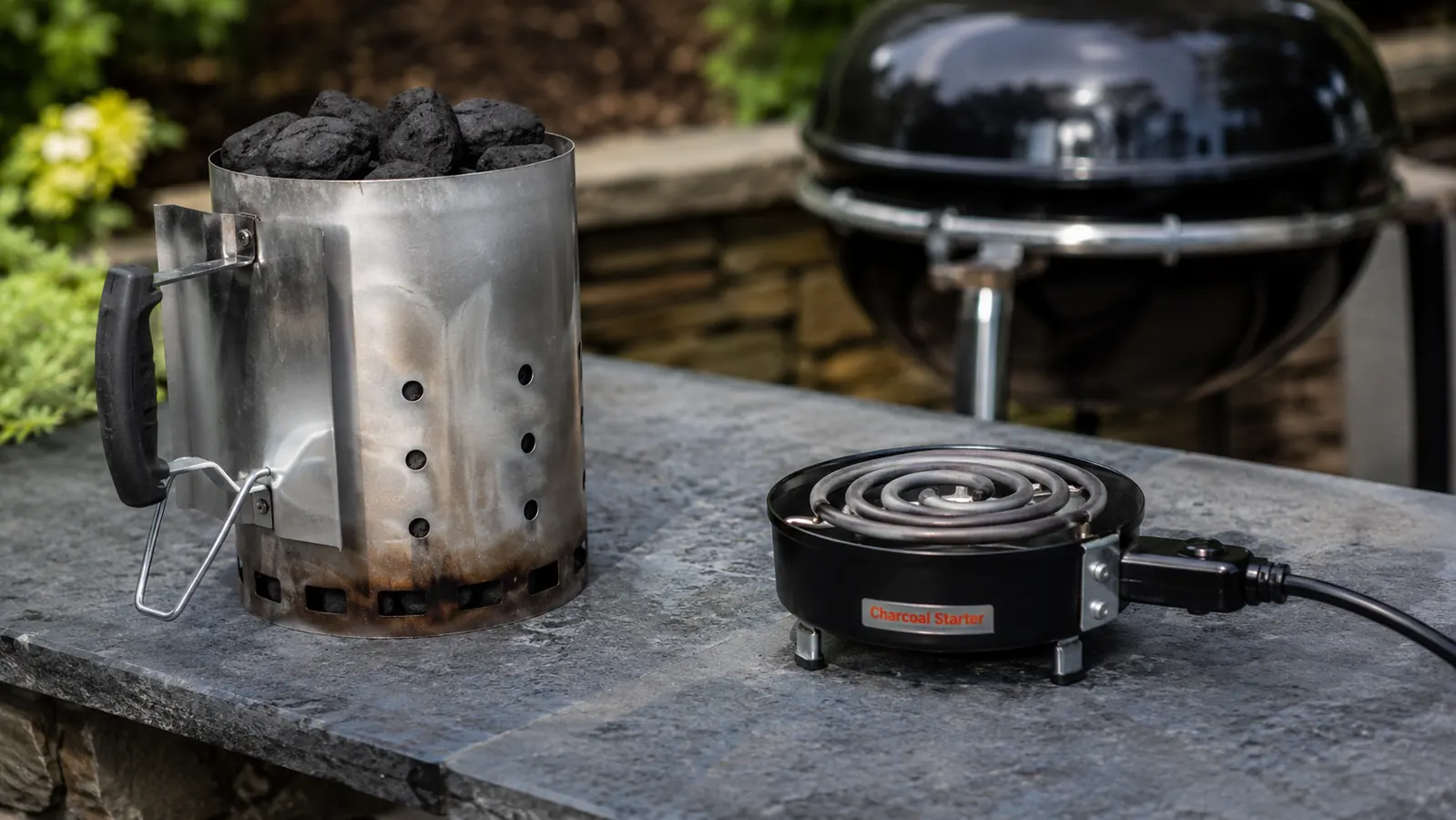
If you have ever stood at the grill at 5:30 on a Saturday, guests arriving in an hour, watching a pile of cold charcoal that refuses to catch, then you know exactly why this comparison matters. I have used both methods to light charcoal. The Weber Rapidfire chimney starter has been my go-to for the better part of two years now, but I spent a full summer running side-by-side tests against an electric coil starter to make sure I wasn't just attached to my routine. Here is what I found.
Short answer: the chimney wins on speed, portability, cost, and real-world reliability. The electric starter has one genuine advantage, and it's not the one most people think it is. I'll walk you through the full picture so you can decide what fits your setup.
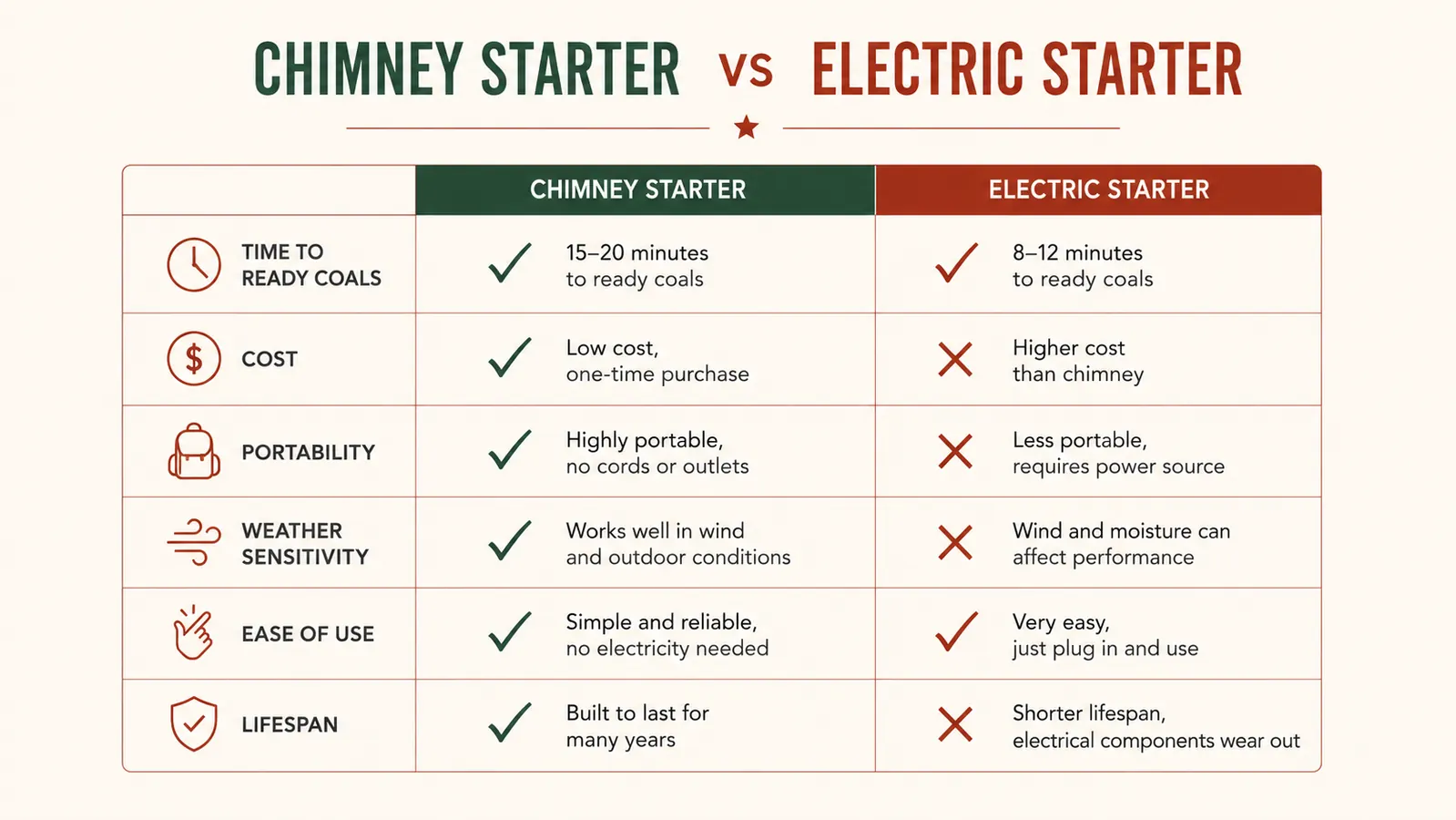
| Weber Chimney Starter | Electric Charcoal Starter | |
|---|---|---|
| Avg. time to cook-ready coals | 10-14 minutes | 22-28 minutes |
| Upfront cost | Around $13 | $15-30 depending on brand |
| Ongoing cost | Newspaper or fire starters (~$0.05 per use) | Electricity (negligible per session) |
| Requires power outlet | No | Yes -- within cord reach of grill |
| Portability | Fully portable, works anywhere | Limited by 6-ft cord length |
| Works in wind | Yes, with basic shielding technique | Yes, coil is not affected by wind |
| Charcoal capacity | Up to ~100 briquettes | Lights the bottom layer, stacking required |
| Risk of flare-up | Low -- no accelerants needed | Very low |
| Durability | Steel handle + heat shield, rated for years | Coil element can burn out in 1-3 seasons |
Where the Weber Chimney Wins
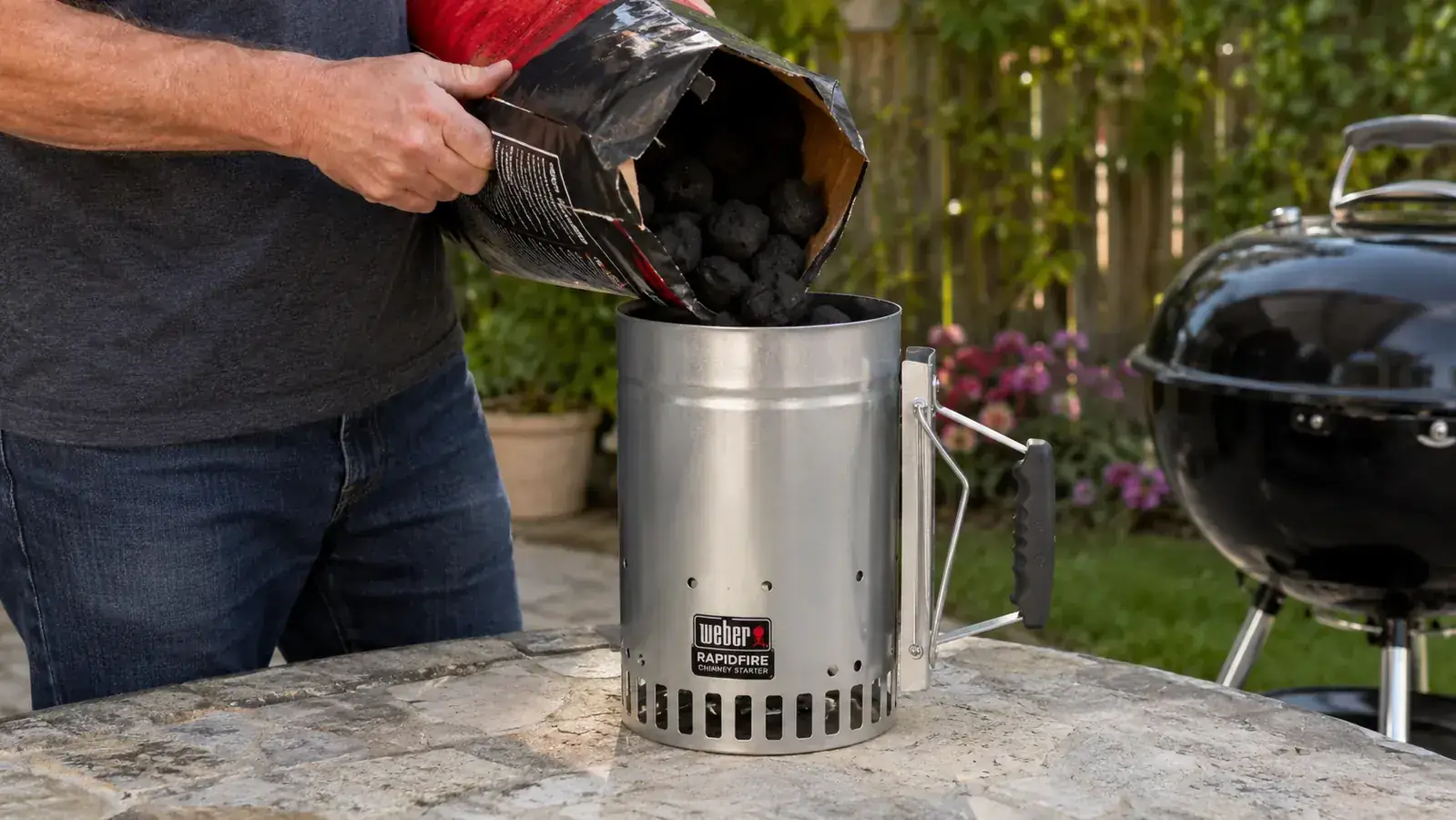
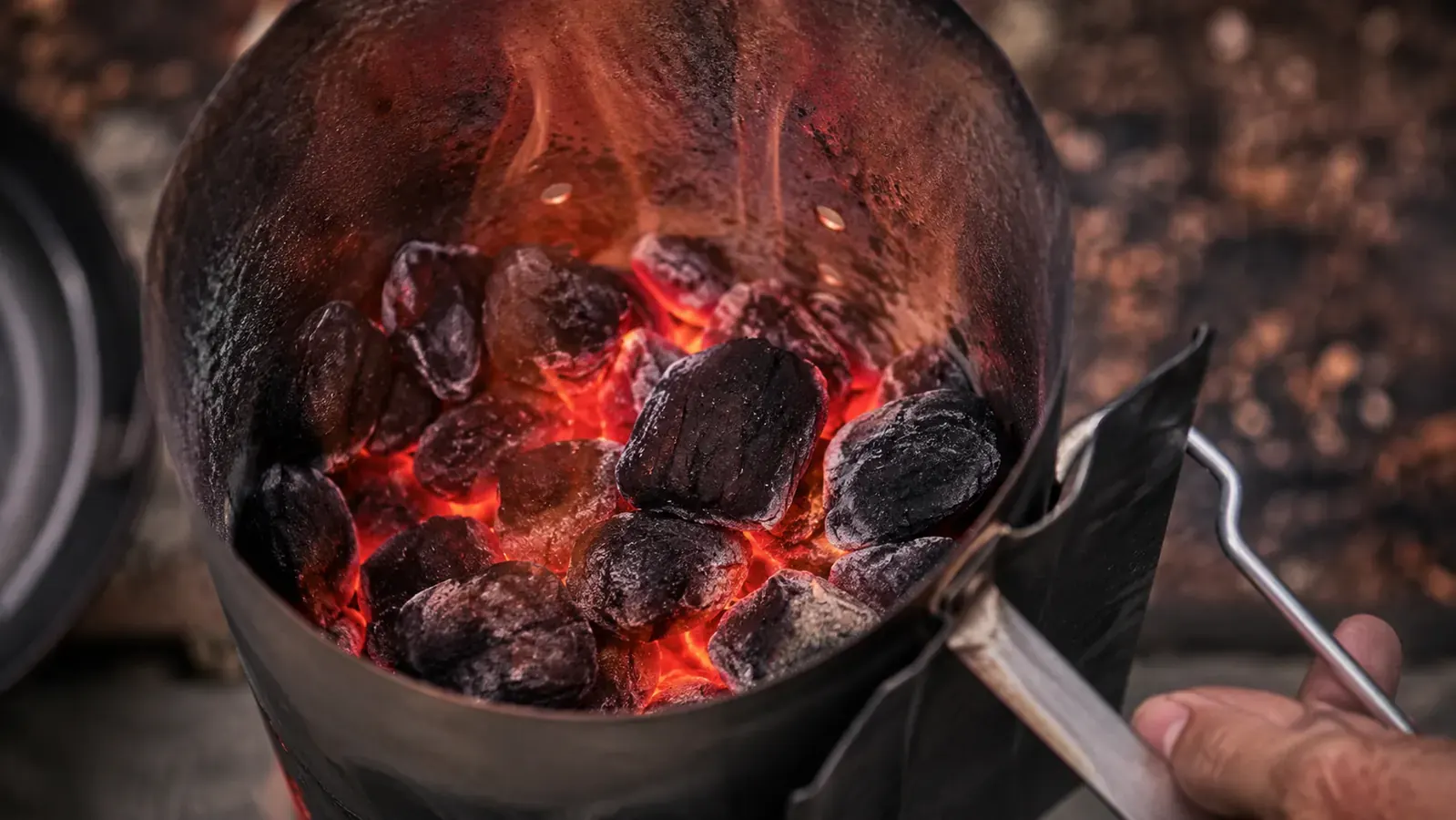
The biggest thing going for the chimney is raw speed. Over ten back-to-back sessions timed on the same kettle grill, the Weber Rapidfire got me to cooking-ready coals in 10 to 14 minutes. The electric coil averaged 22 to 28 minutes. That gap looks small on paper but it is a meaningful chunk of time when you are trying to get food on the grill before your family gives up and orders pizza.
The second win is portability. My kettle sits about 30 feet from the nearest outlet. If I take the grill to a park or a tailgate, there is no outlet period. The chimney goes wherever the charcoal goes. You stuff a couple of sheets of newspaper in the bottom, set a fire, and you're done. There is no cord to manage, no extension cord to trip over, and no worrying about whether the outlet is GFCI protected. For anyone who grills outside their backyard even occasionally, this matters more than the electric crowd usually admits.
Cost is the third win, and it is a comfortable one. The Weber chimney runs about $13 at current pricing. A decent electric coil starter runs $15 to $30. You're spending about the same upfront, but the chimney has no moving parts and no heating element to burn out. Mine is going on year two with zero signs of wear beyond some normal discoloration from heat. Electric coils, in my experience, start losing efficiency after a season or two and eventually fail entirely. You then either buy a replacement coil or a new unit. The chimney just keeps working.
Where the Electric Starter Wins
Here is where I'll be straight with you: the electric coil starter has one real advantage, and it is the hands-off factor during the ignition phase. You nestle the coil into the pile of briquettes, plug it in, and walk away. There is no paper or fire starter to deal with, no small flame to nurse before the coals catch. If you are someone who finds that initial lighting step annoying, or if you have ever had wet newspaper cause a failed start, the electric removes that particular frustration.
That said, you still have to babysit the pile because the coil only gets the bottom layer going. Unlike the chimney, which creates a consistent rising-heat column that lights the whole batch uniformly, the electric coil starts from one point and relies on the coals spreading the heat on their own. You often end up with a hot zone at the bottom and cooler briquettes on top, which means more stirring and waiting. The chimney's design solves this by design. Still, if your outlet is right next to the grill and you don't mind the slower pace, the electric works fine. I just can't call it faster.
If you want charcoal ready before your guests start eyeing the chips, the chimney is the move.
The Weber Rapidfire has 42,000+ Amazon reviews for a reason. It outpaces an electric starter by nearly 15 minutes in real-world tests, costs about the same, and never needs a plug.
Amazon Check Today's Price on Amazon →Ten tests. Same grill, same charcoal, same weather. The chimney was ready to cook before the electric starter had even finished lighting the bottom row.
A Quick Note on How I Ran the Tests
Same kettle grill, same bag of Kingsford Original briquettes, same approximate ambient temperature (mid-60s to low 70s, light wind). I used a standard 16-inch electric coil starter on one side of the sessions and the Weber Rapidfire on the other. I defined 'cook-ready' as all coals at least partially ashed over with surface temperature above 400 degrees confirmed with my instant-read thermometer held near the grate. That's a real-world standard, not a lab standard. The chimney hit it faster every single time.
I also want to be honest about one chimney variable: newspaper and fire starters. The chimney requires some kind of starter fuel underneath. If you use dry newspaper, a single sheet works fine on most days. In high humidity or damp conditions, I use a Weber fire starter cube instead of newspaper, and it lights first try every time. That adds maybe 30 cents per session. The electric removes this step, but it also adds 10 to 15 minutes to your total wait time. I'll take the 30 cents.
Capacity: Why It Matters for Different Cooks
The Weber Rapidfire compact model holds roughly 80 to 100 briquettes comfortably. For a standard kettle grill doing burgers, chicken, or a rack of ribs, that is enough to fill your two-zone setup without a second load. The electric coil doesn't have a fixed capacity in the same way, but it lights from the center out and requires you to arrange the coals yourself around it. If you are trying to fill a large charcoal grate, you will be waiting longer for full coverage.
For smaller grills -- a tabletop kettle or a hibachi -- the electric coil is actually a reasonable fit because you're not moving a lot of charcoal anyway. But most backyard grillers are working a 22-inch kettle or larger, and for those setups, the chimney is the faster, more efficient tool by a clear margin. I cover the full process in detail over in my long-term Weber chimney starter review if you want the deep dive on technique.
The Flavor Question Nobody Talks About
This one doesn't get enough attention. Electric starters don't add any flavor, but they also don't subtract any. Neither does the chimney -- as long as you skip the lighter fluid. The whole reason to use either of these methods instead of squirting accelerant on the briquettes is to keep your food tasting like food. Both the chimney and the electric coil accomplish that. If you are still using lighter fluid and wondering why your chicken tastes like petroleum, both of these are a step up regardless of which you pick. I go into this more in my piece on why a chimney starter beats lighter fluid if you want the full case.
Who Should Buy Which
Buy the Weber Rapidfire chimney if you grill on a standard kettle, want your coals ready in under 15 minutes, and don't want to depend on a power outlet being nearby. That's most backyard grillers. It is faster, more portable, and built to last. At the current price, it is also one of the better investments you can make in your charcoal setup.
Consider an electric coil starter if your grill lives on a covered porch with an outlet directly next to it, you only grill in warm dry weather, and the hands-off ignition step is genuinely important to you. Maybe you have limited mobility and bending over to light newspaper is uncomfortable. That's a fair reason to choose the electric. For everyone else, the chimney is the better tool.
One more thing worth saying: these two are not mutually exclusive in a theoretical sense, but in practice, once you own the chimney, you won't reach for anything else. It takes about three uses to get the feel for it, and after that it becomes as natural as filling the grill. Most of the 42,000 Amazon reviewers on the Weber chimney page say the same thing.
The Weber chimney starts coals faster, travels anywhere, and costs the same as most electric options.
If you are grilling on charcoal more than a few times a month, this is the one tool that pays for itself immediately in time saved. Rated 4.8 stars across 42,000+ reviews.
Amazon Check Today's Price on Amazon →