
I have ruined more steaks by guessing than I care to count. For years I did what most backyard grillers do: I poked the meat with my finger, watched the juices run, and pulled it when it felt right. Half the time it was right. The other half I was standing over a grey, overcooked piece of meat trying to convince myself it was still good. It was not. The fix turned out to be a fourteen-dollar thermometer and five minutes learning where to put it. Once you know the target temperatures and the right way to probe, you stop guessing entirely.
The ThermoPro TP19H is what I reach for on every cook now. It reads in about one second, folds flat so it fits in a pocket, and wakes up the moment you pick it up. No buttons to fumble with while your hands are covered in rub. If you want the full review, I wrote it up at ThermoPro TP19H Review: One Year of Pulling It Out at Every BBQ and Dinner. For now, let us talk about how to actually use it on a steak.
If your last steak was grey in the middle, this is the tool that fixes it.
The ThermoPro TP19H reads in one second flat, folds into your pocket, and never needs you to press a button. Over 54,000 grillers have bought it. There is a reason for that.
Amazon Check Today's Price on Amazon →The Steak Doneness Temperature Chart You Should Have Memorized
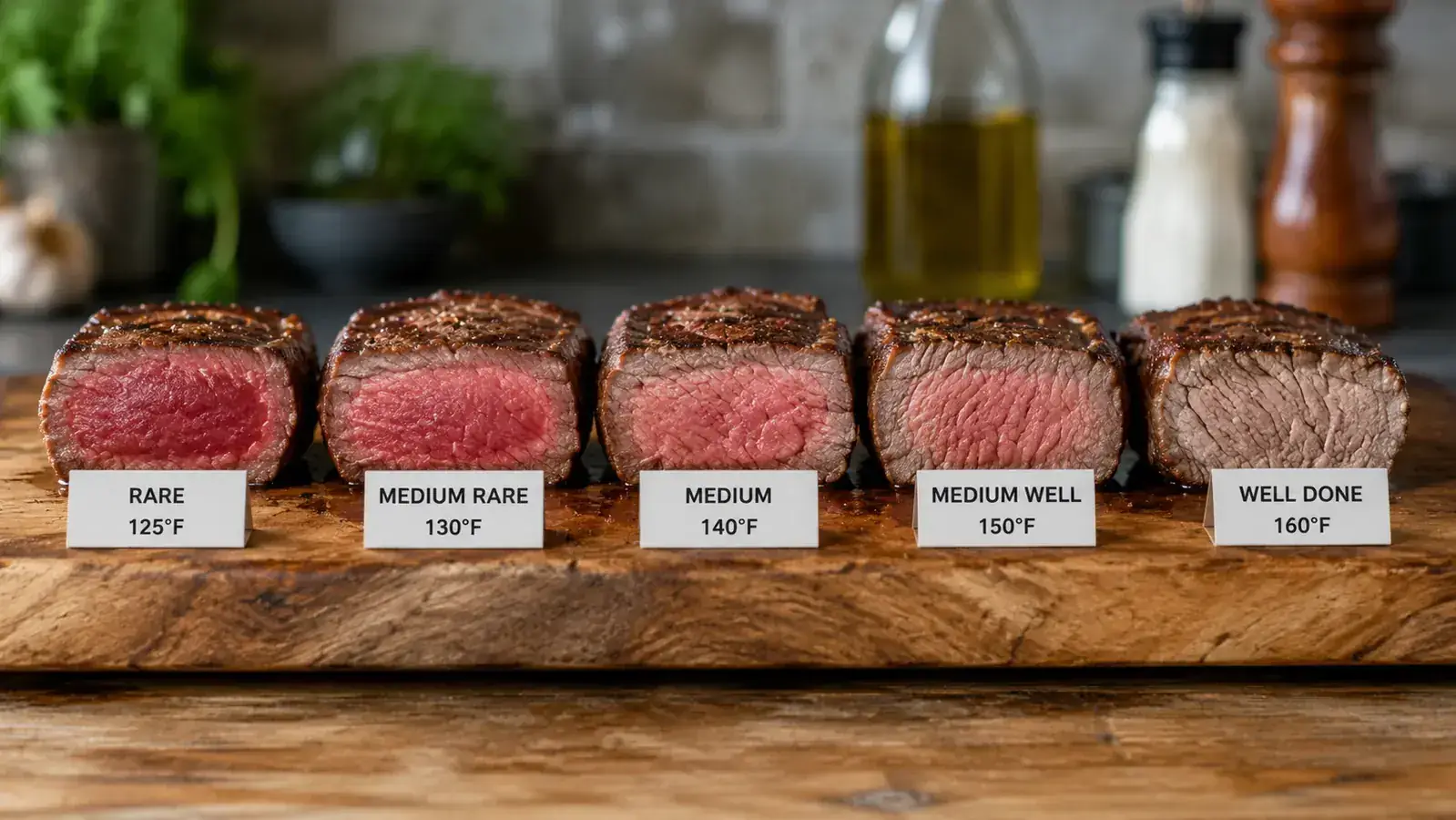
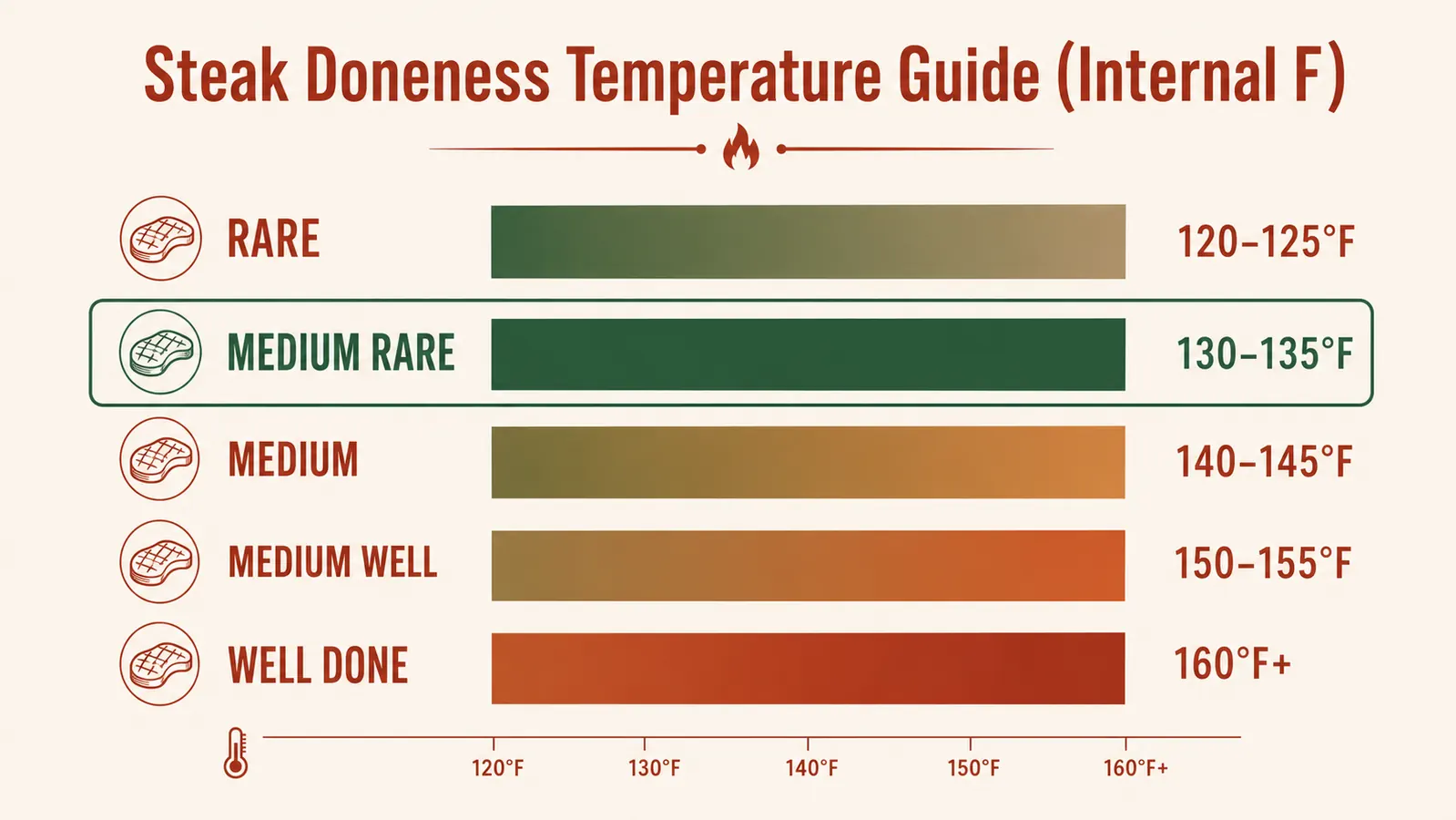
Before we get into technique, nail these numbers down. These are the pull-off-grill temperatures, meaning the internal reading you want to see right before the steak comes off the heat. Carryover cooking will push the final temperature up another three to five degrees while the steak rests, so you want to pull slightly early rather than hitting the exact target.
Rare: pull at 120 to 125 degrees Fahrenheit. The center will be cool, bright red, and very soft. Most people who say they want rare actually want medium-rare once they see it. Medium-Rare: pull at 130 to 135 degrees Fahrenheit. This is the sweet spot for almost every cut. The center is warm, deep pink, with good juice. Medium: pull at 140 to 145 degrees Fahrenheit. Pink fades toward the edges, firm texture, still juicy if you pulled on time. Medium-Well: pull at 150 to 155 degrees Fahrenheit. Just a trace of pink at the very center. The window is narrow here, so precision matters more, not less. Well-Done: 160 degrees Fahrenheit and above. No pink, firmer throughout. Not my preference, but a precise thermometer is the only way to hit it without going to 180 and ruining the texture entirely.
Step 1: Let the Steak Warm Up Before It Hits the Grill
Pull your steak from the fridge 30 to 45 minutes before cooking. A cold steak takes longer to cook through and creates a wider grey band between the crust and the pink center. You are looking for an even cook, and a steak that is already close to room temperature gets there faster and more evenly.
While you are waiting, set up your grill for two-zone cooking if you are working with anything over an inch thick. That means a hot side for searing and a cooler side for finishing. Thinner steaks, half an inch or less, can go straight over direct heat the whole way. Thicker cuts need the hot zone for color and the cooler zone to bring the interior up to temperature without burning the outside.
Pat the steak dry with paper towels before it goes on. Moisture on the surface steams instead of sears. A dry surface forms a better crust faster, which means you spend less time over the heat and keep more juice inside.
Step 2: Know When to Take the First Temperature Reading
Do not probe too early. If you stab the steak the moment it hits the grill you are just pushing around cold meat and getting an inaccurate read. For a one-inch steak over high heat, wait until after the first flip. For a thick cut like a one-and-a-half inch ribeye or a two-inch tomahawk, wait until you have moved it to the cooler zone and given it a few minutes to finish.
A rough timing guide: a one-inch steak over direct high heat needs about three to four minutes per side for medium-rare. Start checking at the three-minute mark. A thick-cut steak gets seared two minutes per side, then moved to the cooler zone where it takes eight to twelve minutes more depending on grill temperature. Start checking at the eight-minute mark. These are starting points, not gospel. A thermometer is your actual guide. The times are just telling you when to start paying attention.
Step 3: Probe From the Side, Hit the Center
This is the step most people do wrong. If you push the thermometer straight down through the top of the steak, you are measuring a small slice of temperature that may not represent the true center. The cold spot in a steak is at its geometric center, and you need the probe tip sitting right there.
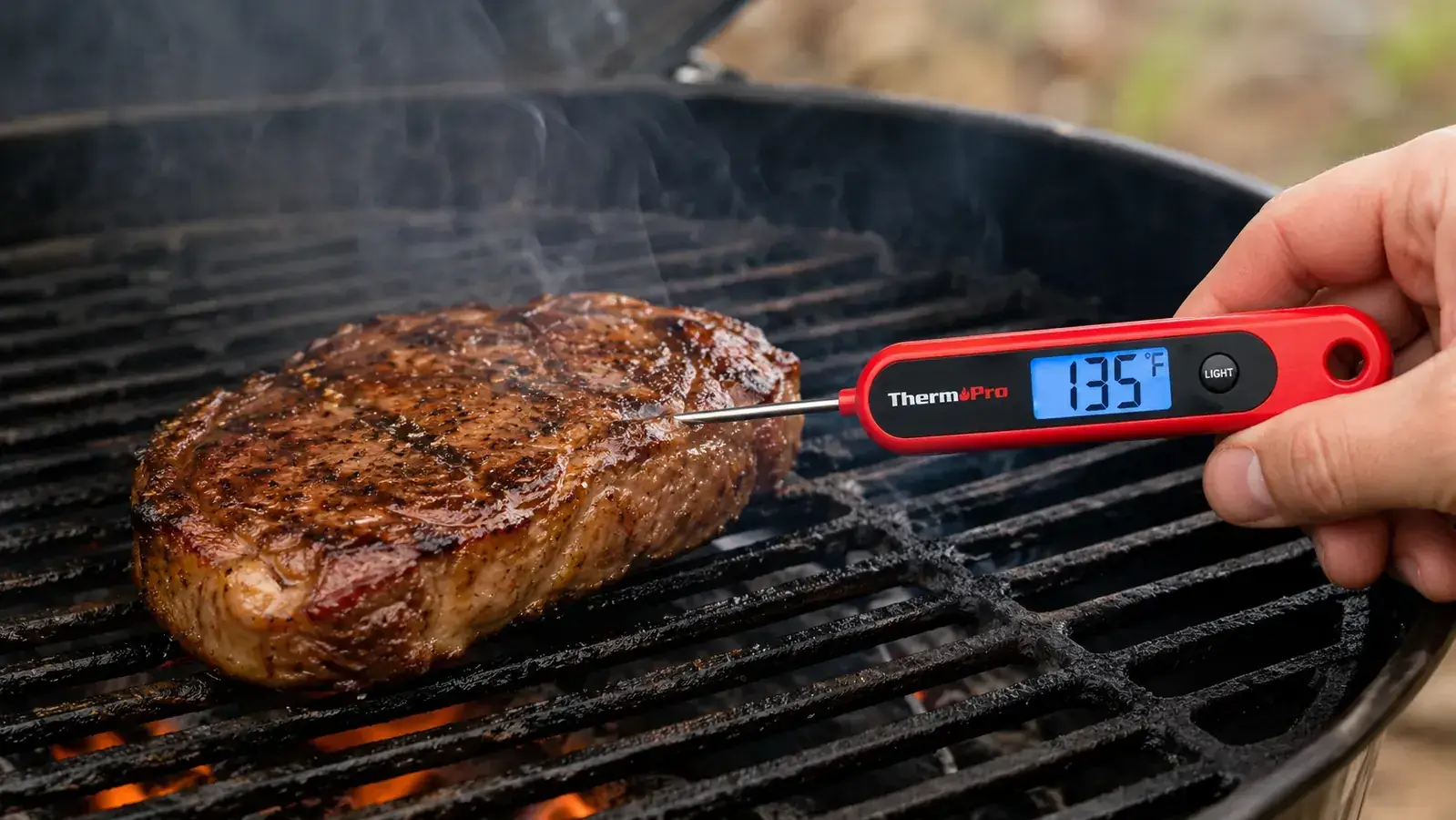
Insert the ThermoPro TP19H probe horizontally through the side of the steak, parallel to the grill grates. Aim for the thickest part, which is usually the center of the cut. The tip of the probe should end up in the middle of the steak from side to side and in the middle from top to bottom. On a thick ribeye, that is roughly an inch and a half in from the side. On a thinner skirt steak, you may need to go in at a slight diagonal to get the tip centered.
The TP19H gives you a reading in about one second. Hold it steady for that one second and you get a stable number. If the number seems off, pull the probe back slightly and re-read. Sometimes the tip is resting against a pocket of fat, which reads different from the muscle. Move a quarter inch and try again.
Step 4: Account for Carryover Heat and Pull Early
Here is where people leave good steaks on the grill too long. They wait until the thermometer reads 135 for medium-rare, pull it off, and cut it immediately. The problem is that the exterior of the steak is hotter than the interior, and that residual heat keeps cooking the meat even after it leaves the grill. This is carryover cooking, and it typically adds three to five degrees to a thick cut.
Pull your steak three to five degrees below your target. For medium-rare, pull at 130 to 132 degrees. For medium, pull at 138 to 140 degrees. Then let it rest on a cutting board for at least five minutes, loosely tented with foil if the air is cold. During that rest, the interior temperature rises to your target, the juices redistribute, and the steak firms up slightly to a better texture. Cutting immediately sends all those juices straight onto your board instead of staying in the meat.
Pull three degrees early, rest five minutes, cut then. That one habit is worth more than any rub or marinade you will ever buy.
Step 5: Verify the Final Temperature After Resting
After the rest, probe again before you cut. This tells you exactly where you landed and helps you calibrate for next time. The reading should be at or slightly above your target. If you hit 133 on the pull and it rested to 137, you are in perfect medium-rare territory. If it rested to 141, you know to pull a little earlier next time. This is how you improve your cook every single session.
The ThermoPro TP19H motion-sensing wake feature is handy here. Set it down on the cutting board while the steak rests, pick it up after five minutes, and it is already on and ready for the final read. No pressing buttons with hands that smell like garlic and char. It just works.
Common Mistakes That Ruin the Read
Probing too close to bone or fat: both read lower than the muscle and will trick you into thinking the steak needs more time. Always target the thickest part of the lean meat and stay away from obvious fat caps or the bone on a T-bone or tomahawk.
Leaving the probe in too long over the heat: the TP19H is designed for quick reads, not for leaving in a hot oven or grill. Insert, read, remove. It is an instant-read thermometer, not a leave-in probe. If you want to monitor temperature without pulling the steak off repeatedly, that is a different tool for a different situation. The comparison between instant-reads and leave-in probes like the MEATER is something I break down in detail at ThermoPro TP19H vs MEATER Probe: Instant-Read vs Leave-In for Backyard Grilling.
Not calibrating your thermometer occasionally: the TP19H holds its calibration well, but if you have dropped it or had it sitting in a hot car trunk, it is worth a quick ice bath test. Fill a glass with ice and water, let it sit two minutes, then probe the water. It should read 32 degrees Fahrenheit. If it is off by more than two degrees, that is a sign to replace it. At the current price, that is an easy decision.
What Else Helps Nail the Perfect Steak
A reliable thermometer is the single biggest upgrade most home grillers can make, but a few other habits stack on top of it. Season generously and early. Salt draws moisture to the surface, which then gets reabsorbed along with the seasoning. If you salt at least 45 minutes before grilling or even overnight in the fridge, you get better flavor penetration and a better crust. Pepper goes on right before the steak hits the grill so it does not burn.
Control your grill temperature. A hot sear zone of 450 to 500 degrees Fahrenheit and a cooler zone of 325 to 375 degrees Fahrenheit give you flexibility for any thickness of steak. If your grill runs cool, you end up steaming instead of searing. If it runs too hot with no cooler zone, you burn the outside before the center has time to climb. Two zones fix both problems. The setup matters as much as the probe, and that is a whole topic on its own.
Use a sharp knife and cut against the grain. Temperature perfection gets wasted on a steak cut with a dull blade or with the grain. Look at the muscle fibers running through the meat and cut perpendicular to them. This shortens the fibers and makes each bite more tender regardless of the cut.
One second to read, fourteen dollars to own, and no more grey steaks.
The ThermoPro TP19H has 54,000-plus reviews on Amazon because it does exactly what it promises. Wake-on-pickup, one-second read, folds flat. If you do not have one yet, this is the one to get.
Amazon Check Today's Price on Amazon →