
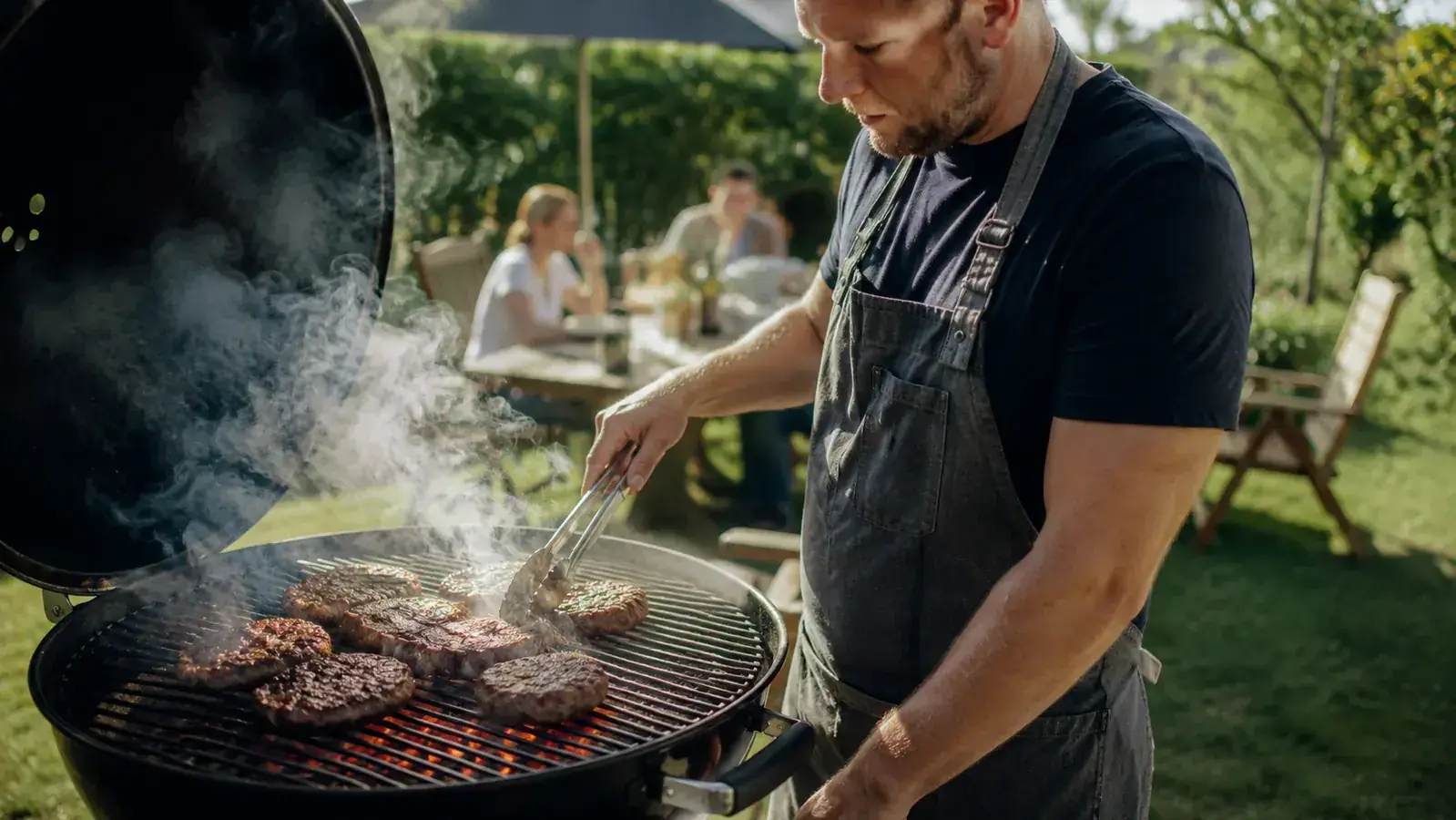
I have owned a gas grill. I cooked on it for two summers, appreciated how fast it lit, and then sold it at a garage sale for forty dollars. The flavor was never there. My neighbors could tell when I switched back to charcoal before I said a word. If you are on the fence between gas and charcoal, I get it. Gas is easy. But easy is not the same as good. Here are the ten reasons I went back to charcoal and have not touched a gas burner since.
My setup these days is the Weber Original Kettle Premium 22-inch. Three seasons in, it has handled everything from weeknight chicken thighs to a fourteen-pound brisket cook that started at midnight. It is the benchmark I am measuring every one of these ten points against. If you are serious about backyard cooking, this is the grill I would hand you.
If you are ready to cook with real fire, the Weber 22-inch Kettle Premium is where I would start.
Over 12,000 reviews averaging 4.8 stars. Built-in thermometer, ash catcher, and heat-control dampers top and bottom. It is the grill I recommend to everyone moving from gas.
Amazon Check Today's Price on Amazon →The Flavor Is Not Even Close
Wood and charcoal combustion produce carbonyl compounds and polycyclic aromatics that deposit on the surface of meat during a cook. These compounds build the bark, deepen the crust, and create the smell that drifts over the fence. A propane flame burns too clean to produce them in any meaningful amount. Gas burns too clean. Charcoal burns dirty in all the right ways. Every backyard pitmaster I know who has cooked on both will tell you the same thing within one bite.
Amazon See the Weber kettle that delivers this flavor on Amazon →

You Can Hit 700 Degrees When You Need To
Charcoal runs genuinely hot. A fully loaded Weber kettle with the dampers wide open can climb past 650 to 700 degrees Fahrenheit. Most home gas grills top out somewhere around 500 degrees, and that is when new. That 150-degree gap is the difference between a real sear and a slow steam. When I want a crust on a ribeye that crackles when I cut it, I need charcoal heat. No gas grill I have used can replicate it.
You Learn to Cook With Fire, Not Dials
Something changes when you stop relying on a knob and start managing live coals. You learn to read a fire. You learn what the grill smells like at 400 degrees versus 550. You get better at every cook because you are paying attention to what is actually happening. Gas is autopilot. Charcoal is actually cooking. If you want to understand what three seasons on a Weber kettle teaches you, the learning curve is most of the point.
The Smoke Ring Is Real, and It Matters
That pink ring just under the bark on a properly smoked brisket or pork butt is the smoke ring. It forms when nitric oxide and carbon monoxide from combustion interact with the myoglobin in meat during a low-and-slow cook. You only get it with real combustion. Charcoal and wood produce it. Propane does not. I have never shown up at a cookout and had someone compliment the smoke ring on food that came off a gas grill.
Amazon Get the Weber kettle that makes long cooks possible →

You Can Add Wood Chunks for Custom Flavor Profiles
Throw a couple of chunks of hickory, apple, cherry, or mesquite directly onto your charcoal and you get a completely different flavor depending on the wood. You cannot do that effectively on a gas grill. Smoker boxes exist, but they produce a fraction of the smoke output. On the Weber kettle, I drop three chunks of apple wood onto a full chimney of lit lump charcoal and the chicken comes off tasting like it spent two hours in a real smokehouse.
Two-Zone Cooking Gives You Total Control
Bank your coals to one side of the kettle and you instantly have a searing zone and an indirect zone in the same grill. Sear the steak over the hot coals, finish it on the empty side. It is the most useful technique in backyard cooking, and it works better on a kettle than on any gas grill I have tried. If you want the full picture, here is how the Weber kettle compares to a kamado for two-zone cooking and overall versatility. The kettle wins at this price.
The Cost to Get Started Is a Fraction of Gas
A decent gas grill with solid construction starts around $400 to $500. The Weber 22-inch Kettle Premium sits well below that, and it will outlast most gas grills in that same price range. My first Weber kettle lasted eleven years before the bowl finally rusted through, and I did not take great care of it. For the flavor you get per dollar spent, charcoal is not a fair comparison.

No Propane Tank Ever Runs Out Mid-Cook
Ask any gas griller and they will have a story about running out of propane halfway through a forty-five minute cook. With charcoal, you either have fuel or you do not, and you know that before the first briquette goes in the chimney. I keep a bag of lump charcoal in the garage and I have never been caught without fuel. Running out of propane at 6:15 pm on a Saturday, with the hardware store twenty minutes away, is a problem I simply no longer have.
Amazon Get the Weber kettle and ditch the propane dependency →
The Grill Is Easier to Deep-Clean
Gas grills have burners, venturi tubes, flavor bars, crossover igniters, heat tents, and grease trays with drain ports. When something clogs or fails, you are troubleshooting a small appliance. A charcoal kettle is a bowl, a grate, a lid, and two sets of dampers. Cleaning it takes five minutes. The one-touch ash catcher on the Weber kettle sweeps ash into a removable cup. You dump it and walk away. Simplicity is underrated in this hobby.
It Makes You Care About What You Are Cooking
This one is harder to quantify, but I believe it matters. When you light a charcoal grill you are committing to the cook. You are waiting for coals to ash over. You are adjusting vents and checking temperature. You are paying attention to the smell and sound of the fire. That level of involvement makes you more deliberate about the food you put on it. My ribs got noticeably better after I switched to charcoal. I think part of that is that I simply started paying closer attention to every step.
Amazon Start cooking with real fire, see the Weber kettle on Amazon →
What I Would Skip
I am not saying gas has no place in a backyard. If you are cooking weeknight burgers for the kids in under ten minutes and speed is the only thing that matters, a gas grill earns its spot. I would skip charcoal if you genuinely cannot give it fifteen minutes of active attention and you are never planning a low-and-slow cook. But if flavor is the reason you grill at all, charcoal wins that argument every single time, and a good chimney starter closes most of the gap on wait time.
My neighbors could tell I switched back to charcoal before I said a word. The flavor does the talking.
The Weber 22-inch Kettle is the grill I would hand someone who wants to know what real backyard BBQ tastes like.
Built-in lid thermometer, one-touch ash sweeper, and dampers top and bottom for precise airflow. At 4.8 stars and over 12,000 verified reviews, it is the most trusted charcoal grill on Amazon for a reason.
Amazon Check Today's Price on Amazon →